
Manufacturing Security: IT/OT Convergence Challenges

Introduction: The Digital Transformation Dilemma
The manufacturing sector stands at a critical crossroads. As Industry 4.0 technologies reshape production environments, the convergence of Information Technology (IT) and Operational Technology (OT) systems has created unprecedented opportunities for efficiency and innovation. However, this convergence has simultaneously introduced complex cybersecurity challenges that many organizations struggle to address effectively.
Traditional manufacturing environments operated with air-gapped systems, where operational technology controlling critical machinery remained isolated from corporate IT networks. This isolation, while limiting connectivity and data-driven insights, provided an inherent security barrier. Today's smart manufacturing demands seamless integration between these previously separate domains, creating attack vectors that cybercriminals are increasingly exploiting.
Recent research such as IT/OT Convergence and Cybersecurity confirms that IT/OT convergence is not a distant prospect but an ongoing reality reshaping industrial cybersecurity. As traditional control systems are increasingly integrated with IoT devices, sensors, and cloud-based analytics, the attack surface has expanded significantly. This shift introduces vulnerabilities that legacy OT systems were never designed to handle, while also creating organisational challenges, since IT and OT teams often operate in silos with different priorities. Effective security strategies therefore require manufacturing organisations to rethink their approaches from the ground up, prioritising visibility, segmentation, and coordinated governance across IT and OT domains.
Understanding IT/OT Convergence: Two Worlds Colliding
Information Technology and Operational Technology serve fundamentally different purposes within manufacturing environments. IT systems focus on data processing, business applications, and connectivity, prioritizing confidentiality and information integrity. These systems are designed for frequent updates, user interaction, and network connectivity.
Operational Technology, conversely, manages physical processes and industrial control systems. OT prioritizes availability and safety, often running on legacy systems designed for stability rather than security. These systems control critical manufacturing processes, from assembly line robotics to heating, ventilation, and cooling systems that maintain optimal production conditions.
The convergence challenge emerges because these systems were never designed to work together securely. Modern manufacturing demands real-time data exchange between OT sensors collecting performance metrics and IT systems analyzing this data for business intelligence. This integration creates security gaps where traditional IT security measures may disrupt critical OT operations, while OT's emphasis on availability can conflict with IT's security-first approach.
Industrial control systems (ICS) and supervisory control and data acquisition (SCADA) systems, historically air-gapped, now require network connectivity to enable predictive maintenance, quality control, and operational optimization. This connectivity exposes manufacturing organizations to cyber threats that can impact both production efficiency and worker safety.
The Expanding Attack Surface: New Vulnerabilities in Manufacturing
The convergence of IT and OT systems has dramatically expanded the attack surface available to cybercriminals. Manufacturing environments now face threats that can propagate from traditional IT networks into operational systems controlling critical machinery and safety systems.
Cybercriminals targeting manufacturing organizations often focus on disrupting production processes, stealing intellectual property, or holding operations hostage through ransomware attacks. The 2010 Stuxnet attack demonstrated how sophisticated threats could target industrial control systems, causing physical damage to equipment and compromising safety systems. This watershed moment highlighted the potential for cyberattacks to cause real-world harm beyond data breaches.
Modern manufacturing cyber incidents frequently exploit the trust relationships between IT and OT networks. Attackers may gain initial access through traditional IT attack vectors such as phishing emails or vulnerable remote access systems, then laterally move into OT environments where security monitoring and controls are often less mature.
The integration of Internet of Things (IoT) devices throughout manufacturing environments introduces additional complexity. These devices often lack robust security features, creating entry points for attackers. Once compromised, IoT devices can provide persistent access to manufacturing networks, enabling long-term reconnaissance and data exfiltration.
To understand how authentication mechanisms can be strengthened across these diverse environments, organizations should examine multi-factor authentication strategies that address both IT and OT system requirements, ensuring that security measures don't disrupt critical production processes.
Security Framework Challenges: Adapting to Converged Environments
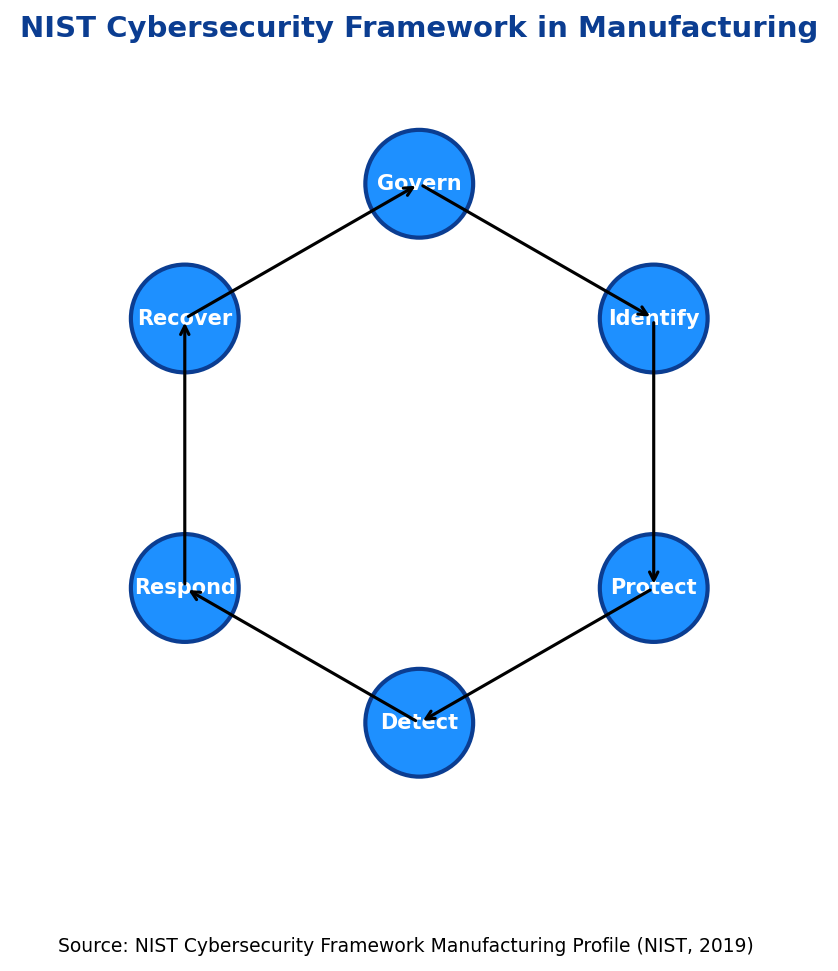
Implementing effective security frameworks in converged IT/OT environments requires careful consideration of both domains' unique requirements. The NIST Cybersecurity Framework 2.0 provides valuable guidance through its six core functions: Govern, Identify, Protect, Detect, Respond, and Recover. However, applying these functions in manufacturing environments requires specialized approaches that account for operational continuity and safety requirements.
The Govern function becomes particularly complex in manufacturing environments where IT and OT teams may have different reporting structures, budgets, and priorities. Establishing unified governance that addresses both cybersecurity and operational safety requires executive leadership and cross-functional collaboration, thus the Cybersecurity Framework Manufacturing Profile by NIST.
Manufacturing organizations must adapt traditional risk assessment methodologies to account for the unique characteristics of OT systems. Unlike IT systems that can be patched or updated regularly, OT systems often require scheduled downtime for maintenance, making real-time security updates challenging.
The convergence also complicates incident response procedures. Traditional IT incident response focuses on containing threats and preserving evidence, while OT incident response prioritizes maintaining production and ensuring worker safety. Manufacturing organizations need integrated response procedures that address both concerns without compromising either objective.
Academic research such as A Scalable Factory Backbone for Multiple Independent Time-Sensitive Networks emphasizes that IT/OT convergence demands development of security strategies that recognise the inherent differences between the two domains, while enabling their integration in a way that enhances operational performance rather than impeding it. For example, the study notes: “Convergence of time-sensitive machine control networks as part of the operational technology (OT) with the ubiquitous information technology (IT) networks is an essential requirement for the ongoing digitalization of production.”
Infrastructure Security in Manufacturing: A DevSecOps Approach
Modern manufacturing increasingly relies on software-defined infrastructure and automated deployment processes, making infrastructure security a critical component of overall cybersecurity strategy. The principles of Infrastructure as Code (IaC) can significantly enhance manufacturing security when properly implemented.
Manufacturing organizations implementing IaC approaches can ensure consistent security configurations across their IT/OT environments. This consistency is crucial when managing hybrid environments where traditional network boundaries no longer provide adequate protection. To learn more about implementing robust infrastructure security practices, organizations can reference comprehensive guidance on Infrastructure as Code security testing that addresses both development and operational requirements.
The integration of DevSecOps practices into manufacturing environments enables continuous security validation throughout the development and deployment lifecycle. This approach is particularly valuable when managing the complex software ecosystem that supports modern manufacturing operations, from enterprise resource planning systems to industrial IoT applications.
Manufacturing organizations should implement automated security testing that validates both code functionality and security requirements without disrupting production systems. This requires specialized testing environments that accurately replicate production conditions while enabling comprehensive security assessments.
Secure Development and Deployment: CI/CD in Manufacturing
The adoption of continuous integration and continuous deployment (CI/CD) practices in manufacturing environments requires careful consideration of operational requirements and safety implications. Manufacturing software systems often control critical processes where deployment errors can result in production disruptions or safety incidents.
Implementing secure CI/CD pipelines for manufacturing requires specialized approaches that address the unique characteristics of OT environments. These pipelines must validate not only code quality and security but also operational safety and compliance requirements.
Manufacturing organizations should establish separate CI/CD pipelines for IT and OT systems, with appropriate controls governing the deployment of changes to production environments. For comprehensive guidance on implementing secure deployment practices, organizations can review detailed strategies for secure CI/CD pipeline design and implementation that address manufacturing-specific requirements.
The integration of security testing throughout the development lifecycle enables manufacturing organizations to identify and remediate vulnerabilities before they reach production environments. This proactive approach is essential in manufacturing where post-deployment patches may require extensive testing and scheduled downtime.
Measuring Success: KPIs for Manufacturing Cybersecurity
Establishing meaningful metrics for manufacturing cybersecurity requires balancing traditional IT security measures with operational performance indicators. Manufacturing organizations need visibility into both security posture and operational impact to make informed decisions about cybersecurity investments.
Key performance indicators for manufacturing cybersecurity should address multiple dimensions: security effectiveness, operational continuity, compliance adherence, and business impact. These metrics must provide actionable insights that enable continuous improvement while avoiding measurement overhead that diverts resources from critical activities.
Manufacturing organizations should establish baseline measurements that capture both security and operational performance before implementing new security controls. This baseline enables accurate assessment of security initiatives' impact on production efficiency and quality.
The measurement framework should include both technical metrics (such as vulnerability discovery and remediation times) and business metrics (such as production uptime and quality indicators). For detailed guidance on establishing comprehensive measurement programs, organizations can explore proven approaches to measuring DevSecOps success through strategic metrics and KPIs adapted for manufacturing environments.
Identity and Access Management: Securing Converged Environments
Identity and access management in converged IT/OT environments presents unique challenges that require specialized approaches. Manufacturing organizations must ensure that authorized personnel can access necessary systems while preventing unauthorized access that could disrupt operations or compromise safety.
Traditional IT identity management systems may not be suitable for OT environments where users require different types of access and authentication mechanisms. Manufacturing organizations need integrated identity management that addresses both domains while maintaining operational efficiency.
The implementation of zero-trust principles in manufacturing requires careful consideration of operational requirements and safety implications. While zero trust provides enhanced security, its implementation must not interfere with critical safety systems or emergency response procedures.
Manufacturing organizations should implement role-based access controls that reflect both IT and OT job functions, ensuring that personnel have appropriate access to perform their duties without excessive privileges that increase security risks.
Emerging Technologies and Future Considerations
The integration of artificial intelligence and machine learning technologies into manufacturing cybersecurity represents both an opportunity and a challenge. These technologies can enhance threat detection and response capabilities while introducing new attack vectors that require specialized security measures.
Manufacturing organizations increasingly utilize AI for predictive maintenance, quality control, and operational optimization. However, these AI systems require robust security controls to prevent adversarial attacks that could manipulate decision-making processes or compromise system integrity.
The emergence of 5G networks and edge computing in manufacturing environments will further complicate the IT/OT convergence challenge. These technologies enable new capabilities while creating additional attack surfaces that require comprehensive security strategies.
Manufacturing organizations must stay informed about emerging technologies and their security implications, ensuring that security strategies evolve to address new threats and opportunities.
Building Resilient Manufacturing Security Programs
Developing effective manufacturing cybersecurity programs requires a holistic approach that addresses technical, organizational, and governance challenges. Organizations must establish security programs that enhance both cyber resilience and operational resilience.
The foundation of effective manufacturing cybersecurity lies in understanding the unique characteristics of IT/OT environments and developing security strategies that address both domains' requirements. This understanding must inform all aspects of the security program, from risk assessment to incident response.
Manufacturing organizations should establish cross-functional security teams that include representatives from IT, OT, engineering, and business units. These teams ensure that security decisions consider all relevant perspectives and requirements.
Training and awareness programs must address the unique challenges of converged environments, ensuring that personnel understand both security requirements and operational implications. This education is crucial for maintaining security while preserving the operational focus that manufacturing organizations require.
Conclusion: Navigating the Security-Operations Balance
The convergence of IT and OT systems in manufacturing environments represents a fundamental shift that requires comprehensive security strategies addressing both domains' unique requirements. Organizations that successfully navigate this convergence will gain significant competitive advantages through improved operational efficiency and enhanced security posture.
Success requires executive leadership, cross-functional collaboration, and a commitment to continuous improvement. Manufacturing organizations must invest in both technology and people, ensuring that security capabilities evolve alongside operational requirements.
The integration of proven DevSecOps practices, comprehensive measurement programs, and robust identity management creates a foundation for secure and efficient manufacturing operations. However, this integration must be carefully planned and executed to avoid disrupting critical production processes.
As manufacturing continues to evolve toward greater connectivity and automation, cybersecurity will become increasingly critical to operational success. Organizations that proactively address IT/OT convergence challenges will be better positioned to capitalize on future opportunities while maintaining the security and safety that manufacturing operations demand.
The journey toward secure IT/OT convergence is complex, but with the right strategies, frameworks, and partnerships, manufacturing organizations can achieve both their operational and security objectives. The time to act is now, before the next cyber incident disrupts production or compromises the critical infrastructure that modern manufacturing depends upon.
Safeguarding IT/OT convergence requires more than technology—it demands expertise, governance, and resilient cybersecurity frameworks. At Emutare Technologies Pty Ltd, we help organizations navigate complex IT, OT, and IoT security challenges with services such as vulnerability management, DevSecOps integration, cybersecurity governance, and incident response.
Explore actionable insights and proven strategies on our blog at insights.emutare.com. Strengthen your digital resilience today — partner with us to secure your operations and gain a competitive edge. The time to act is now.
References
Maleh, Y. (2021). IT/OT convergence and cybersecurity. ResearchGate. https://www.researchgate.net/publication/352330231_ITOT_convergence_and_cybersecurity
Emutare Technologies Pty Ltd. (2025). Multi-Factor Authentication: Comparing Different Methods. https://insights.emutare.com/multi-factor-authentication-comparing-different-methods/
Stouffer, K., Newhouse, W., & Crawford, M. (2019). Cybersecurity framework manufacturing profile low impact level example implementations guide: Volume 1 – General implementation guidance (NIST Interagency/Internal Report No. 8183A-1). National Institute of Standards and Technology. https://doi.org/10.6028/NIST.IR.8183A-1
Lautenschlaeger, W., Frick, F., Christodoulopoulos, K., & Henke, T. (2021). A scalable factory backbone for multiple independent time-sensitive networks (Version 2) [Preprint]. arXiv. https://doi.org/10.48550/arXiv.2110.01241
Emutare Technologies Pty Ltd. (2025). Infrastructure as Code Security Testing: Securing the Foundation of Modern IT. https://insights.emutare.com/infrastructure-as-code-security-testing-securing-the-foundation-of-modern-it/
Emutare Technologies Pty Ltd. (2025). Secure CI/CD Pipelines: Design and Implementation.
https://insights.emutare.com/secure-ci-cd-pipelines-design-and-implementation/
Emutare Technologies Pty Ltd. (2025). Measuring DevSecOps Success: Metrics and KPIs.
https://insights.emutare.com/measuring-devsecops-success-metrics-and-kpis/